
Why Being "Good" Isn't Enough Anymore
Most UK service businesses think they're losing work because of price.
"We're being undercut." "Customers just want the cheapest option." "Margins are getting tighter."
But in reality, price usually isn't the real reason you're losing jobs.
The uncomfortable truth?
You're losing because you responded too slowly - or not at all.
In today's on-demand economy, the business that replies first usually wins, even if they're more expensive.
The Modern Customer Doesn't "Shop Around" Like They Used To
Think about how customers behave now. Someone needs:
- an electrician
- a plumber
- an accountant
- a consultant
- an emergency repair
They don't sit down with a spreadsheet. They:
- Call the first 2–3 results
- Go with whoever responds fastest and most confidently
If you don't answer - or reply hours later - you're already out of the race.
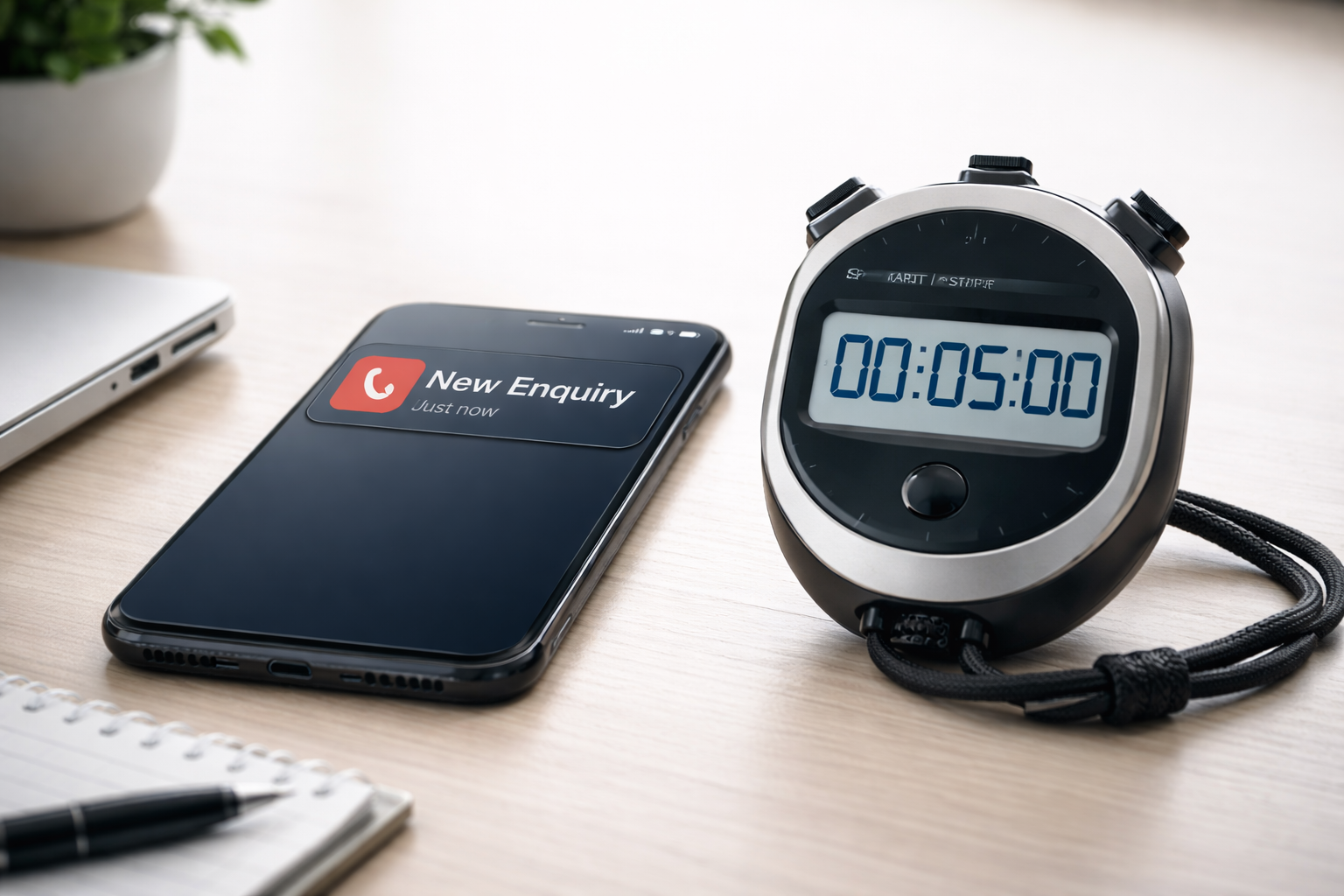
The 5-Minute Rule (And Why It's Brutal)
Across sales and lead response research, a consistent pattern shows up again and again:
- Respond within 5 minutes → dramatically higher conversion
- Respond after 30 minutes → conversion drops sharply
- Respond after 1 hour → most leads are already gone
This applies just as much to calls as it does to forms, WhatsApp, and enquiries.
Speed signals professionalism and reliability. Silence signals risk - even if you're the best at what you do.
Speed signals
- professionalism
- reliability
- competence
Silence signals
- disorganisation
- low availability
- risk
Even if that feels unfair - it's how customers make decisions in the moment.
Why "I'll Get Back to Them Later" Fails at Scale
Early on, you can manage everything yourself. As your business grows:
- calls increase
- enquiries overlap
- jobs run long
- admin piles up
You start triaging instead of responding.
That's when cracks appear:
- callbacks get forgotten
- messages stack up
- leads cool off
- competitors step in
The business doesn't fail - it just stalls. Not because demand disappears. Because response speed collapses under growth.
Hiring More Staff Doesn't Fully Solve This
Many businesses try to fix speed with people. That helps - but it has limits:
- humans can only handle one conversation at a time
- holidays, sick days, lunch breaks happen
- costs scale linearly with volume
Worst of all? Most staff still can't respond instantly, 24/7.
The bottleneck just moves - it doesn't disappear.
Speed Is Now a Systems Problem, Not a People Problem
High-performing service businesses are solving this differently.
Instead of asking: "How do we work harder?" They ask: "How do we respond instantly - every time - without burning out?"
That's where automation comes in. Not automation that replaces humans - but automation that captures, qualifies, and routes demand instantly.
What "Fast Response" Actually Looks Like Today
Modern AI-powered reception systems can:
- answer every inbound call immediately
- handle multiple enquiries at the same time
- qualify the caller
- book appointments directly
- log the lead automatically
- escalate only high-value or urgent cases
All without waiting for someone to become free.
From the customer's perspective: "These guys were on it."
From the business owner's perspective: "Nothing slipped through the cracks."

Speed Compounds Just Like Marketing Does
Here's the overlooked part. Improving response speed:
- increases conversion rate
- improves customer perception
- raises average job value
- reduces marketing waste
You don't need more leads if you convert more of the ones you already get.
That's why speed to lead is one of the highest-ROI improvements a service business can make.
The Businesses Winning in 2026 Aren't the Cheapest
They're the fastest.
- fastest to answer
- fastest to confirm
- fastest to book
- fastest to reassure
Price becomes secondary when confidence is high - and confidence comes from responsiveness.
Final Thought
If you're investing in:
- ads
- SEO
- referrals
- partnerships
…but your response time is slow or inconsistent…
You're pouring water into a leaky bucket.
Fix the response system, and everything else performs better.
If you want to explore how always-on reception and automation can eliminate response delays entirely, that's exactly what we help UK businesses implement.
Ready to respond faster than your competitors - without hiring more staff?
We'll set up an AI receptionist that answers, qualifies, and books appointments - so you can focus on delivery and growth.