
The Front Desk Is Quietly Running Your Clinic
In most veterinary practices and healthcare clinics, the reception desk is treated as an administrative function.
Answer the phone.
Book appointments.
Take messages.
Keep things moving.
But in reality, reception controls something far more important:
Patient experience, revenue flow, and clinical efficiency.
And when reception struggles - even slightly - the entire clinic feels it.
A Typical Day at a Busy Clinic
Picture a normal weekday morning.
- The waiting room is full
- A vet or clinician is already running behind
- A nervous pet owner needs reassurance
- Another patient is checking in
- The phone keeps ringing
The receptionist is doing their best - but they're stuck in an impossible role.
They're expected to:
- manage in-person patients
- handle multiple phone calls
- triage urgency
- book appointments accurately
- stay calm and compassionate
- avoid mistakes
All at the same time.
No matter how skilled they are, something has to give.

When Reception Falls Behind, Everyone Pays
Unlike many businesses, clinics don't just lose "leads" when calls go unanswered or rushed.
They lose:
- appointment slots
- treatment continuity
- patient trust
- staff morale
A missed or mishandled call might mean:
- a pet owner delays treatment
- a patient goes elsewhere
- a follow-up is forgotten
- a clinician's schedule becomes chaotic
Reception isn't just admin - it's clinical flow control.
The Hidden Cost of Interruptions
In clinics, interruptions are constant.
Every phone call pulls attention away from:
- checking in patients
- handling payments
- updating records
- supporting clinicians
This creates a ripple effect:
- queues grow
- stress increases
- mistakes become more likely
- patients feel rushed or ignored
Ironically, the very role meant to create calm becomes the centre of pressure.
Hiring More Receptionists Isn't a Perfect Fix
Many clinics respond by adding staff.
That helps - but only up to a point.
Human receptionists:
- can only handle one call at a time
- still get overwhelmed during peak hours
- still need breaks, holidays, sick days
- still rely on manual systems
And in healthcare settings, turnover can be especially disruptive due to training requirements and patient sensitivity.
The bottleneck shifts - it doesn't disappear.
Clinics Are Not Short on Care - They're Short on Capacity
This is the part most clinics miss.
The problem usually isn't:
- lack of compassion
- lack of expertise
- lack of demand
It's lack of front-desk capacity.
The phones don't stop ringing.
Patients still need answers.
Appointments still need booking.
But the system can't absorb the volume smoothly.
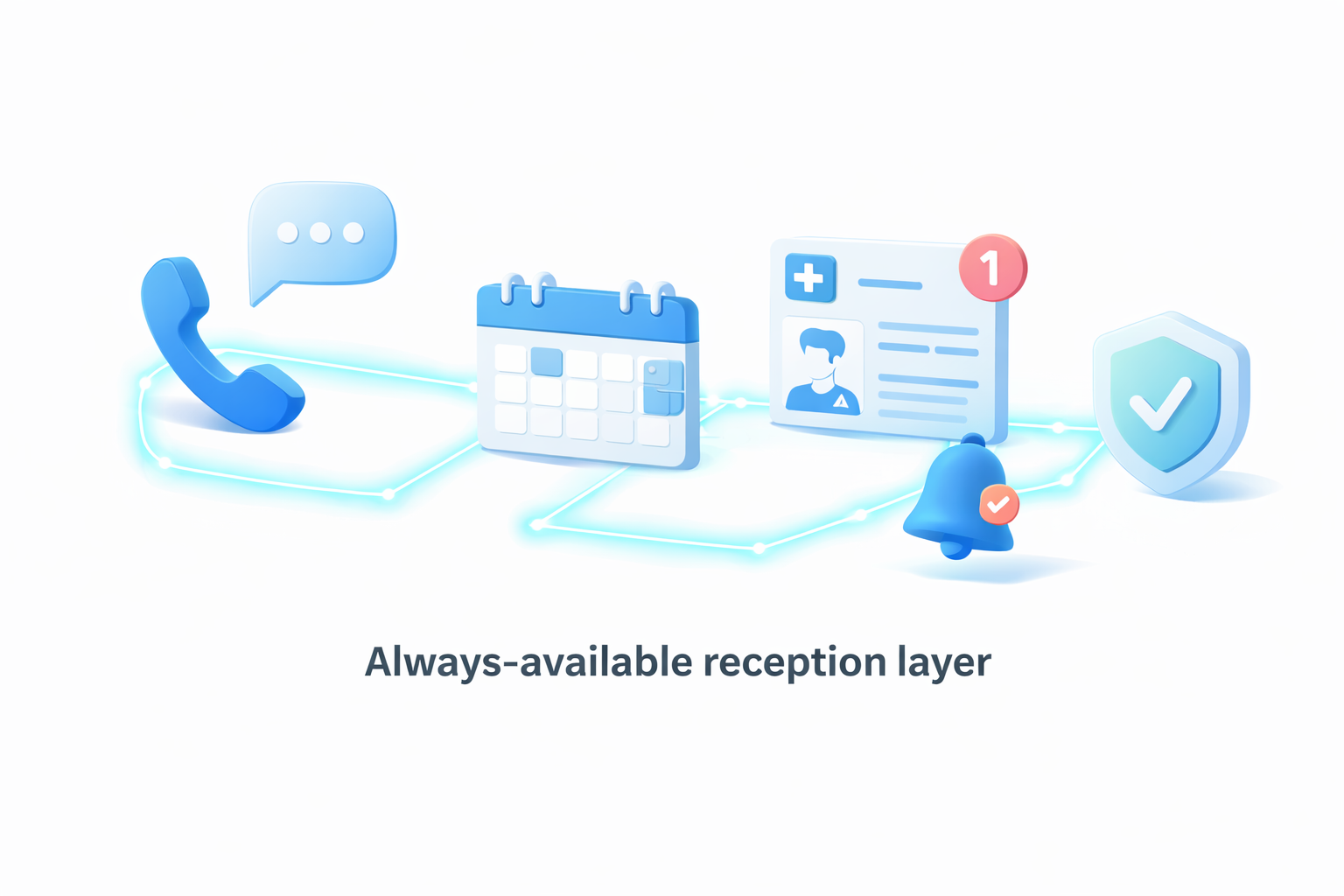
What an "Always-Available" Reception Layer Looks Like
Modern clinics are starting to separate human care from transactional handling.
Instead of forcing receptionists to do everything, they use intelligent automation to handle:
- incoming calls
- appointment scheduling
- basic triage questions
- opening hours, pricing, policies
- confirmations and reminders
This creates a buffer between demand and staff.
Patients get immediate responses.
Receptionists get breathing room.
Clinicians get cleaner schedules.
Why This Improves Care, Not Just Efficiency
There's a misconception that automation feels cold - especially in healthcare.
In practice, the opposite often happens.
When routine interactions are handled consistently:
- staff have more time for empathy
- patients feel acknowledged immediately
- fewer conversations are rushed
- fewer details are missed
Automation doesn't replace human care - it protects it.
The Clinics That Thrive in the Next Decade Will Feel Calm
The most successful clinics won't be the busiest.
They'll be the ones that feel:
- organised
- responsive
- calm under pressure
Where:
- phones are always answered
- appointments flow smoothly
- staff aren't constantly firefighting
- patients feel supported, not hurried
That calm isn't accidental. It's engineered.
Final Thought
In veterinary and healthcare settings, reception is not a cost centre.
It's the nervous system of the clinic.
If it's overloaded, everything suffers.
If it's supported, everything improves.
The future of patient experience won't be built on working harder at the front desk - but on building systems that quietly carry the load.
Exploring smarter reception for your clinic?
If you're exploring ways to reduce front-desk pressure without compromising patient care, modern reception automation can make a measurable difference - for staff and patients alike.
Request a Demo